
Human Movement Research Sensors
Wearable accelerometers built for scientific measurement. Used in longitudinal studies, clinical trials and population research worldwide.
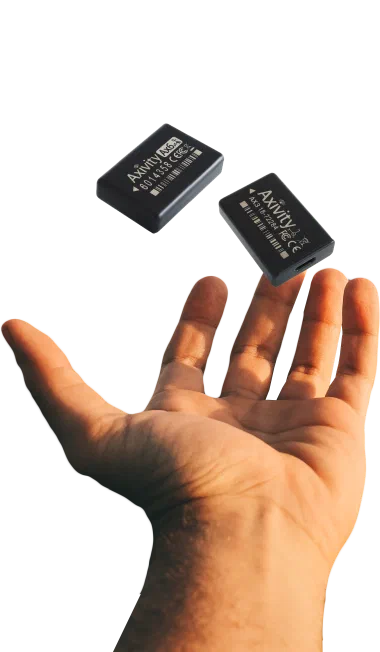
1Raw triaxial acceleration
The signal, before anyone decides what it means
An Axivity device records continuous triaxial acceleration and hands it over unchanged, in an open format. There is no proprietary scoring algorithm between the measurement and the analysis, so the record below is what the instrument wrote, not a summary of it.
Time (days)
2Instruments
Two loggers, both built for multi-day recording
Both devices write to on-board flash against a real-time quartz clock, are configured in batches with OMGUI, and download as .CWA files.
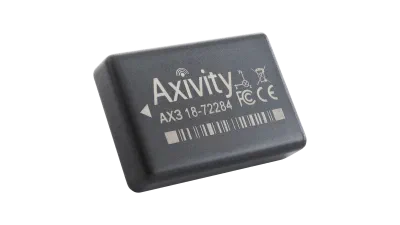
AX33-axis logging accelerometer
A data logger with a MEMS 3-axis accelerometer, flash on-board memory, real-time quartz clock and temperature sensor. Built for longitudinal movement data.
£139.00–£149.00 exc VAT
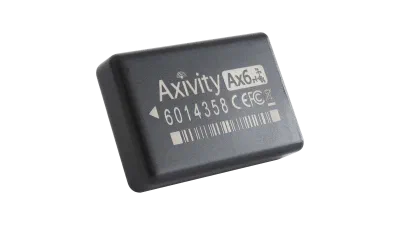
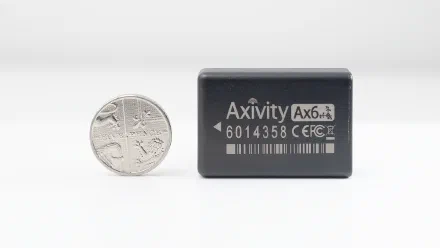
AX66-axis logging accelerometer
Records raw data from a 6-axis movement sensor measuring linear acceleration and angular velocity. Sensor placement matches the AX3 for compatibility.
£199.00–£209.00 exc VAT
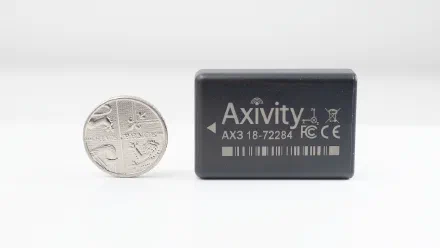
AX3
AX6
Full catalogue, including accessories and discontinued hardware
3Published record
Measured in work you can check
Four papers below, from four different fields. The rest are on the publications page.
Published studies and conference papers that used an Axivity device
Nearly all link straight to the paper, so you can check that the measurement was ours and the finding is theirs. Coverage depends on researchers reporting their own work. Papers are missing.
UK Biobank added seven-day wrist measurement with the AX3 in 2012, at population scale. The methods paper is below.
Population cohort
Parkinson's disease
Equine biomechanics
Wear compliance
All publications, searchable by year and keywordThe UK Biobank deployment
4Applications
What people measure with them
Fourteen days at 100 Hz on an AX3, or a month at low rates on either device.
- Physical activity measurement
- Free-living intensity, sedentary time, and whether the device was worn at all.
- Sleep and rest timing
- Nocturnal movement and wake episodes, scored by whichever algorithm you trust.
- Animal behaviour studies
- Worn by horses and dogs as well as people.
- Clinical and movement research
- Gait, postural transitions and tremor, on the raw signal.